Access Equipment for Warehouses and Distribution Centres: A Complete Guide
Posted by Aluminium Platforms on 7th Jun 2026
Warehouses and distribution centres present specific access challenges that general-purpose equipment doesn't always solve well. High racking, narrow aisles, heavy picking frequency, and the constant movement of workers and equipment create a combination of requirements that makes equipment selection more consequential than in many other environments.
The Access Challenge in Modern Warehouses
Modern warehousing is characterised by high-density storage, compressed margins, and high throughput. Workers access elevated racking dozens or hundreds of times per shift. The equipment they use for that access directly affects productivity, fatigue, and injury risk. A slow, awkward access solution multiplies its impact across every pick cycle.
The key access needs in most warehouses and distribution centres include:
- Elevated shelf and racking access for picking, put-away, and stocktaking
- Mezzanine and elevated platform access for storage or work areas
- Machine and equipment maintenance at height
- Overhead infrastructure access for installation and maintenance
Work Platforms: The Standard for Repetitive Height Access
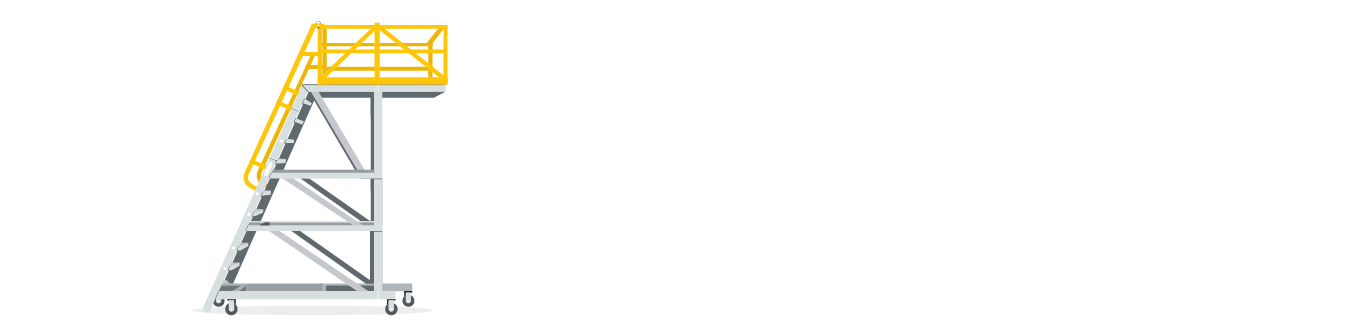
For tasks accessed repeatedly throughout the shift — particularly racking access above 1.5 metres — a mobile work platform provides a significantly better outcome than a ladder. The full-deck standing area allows both hands free, reduces the fatigue associated with maintaining balance on rungs, and provides a safer working position for tasks that take more than a brief moment.
Star Aluminium P-series work platforms are the most common choice for warehouse environments in Australia. Key specifications to match to your racking height:
- 4-step platform (~): Light overhead access, top shelf on standard racking up to approximately 2.8m overall height
- 5-step platform (~): Mid-high racking access, general overhead work
- 7-step platform (~): High-bay racking, facilities maintenance work
- 9-step platform (~): Very high bay access, tall-bay warehouse environments
- 12-step platform (~): Maximum-height warehouse applications
Work platforms roll on lockable castors, allowing quick repositioning along the racking face without lifting. The staircase provides a safe, loaded ascent path when workers carry picked items or tools.
Order Picking Platforms
For narrow-aisle warehouse environments where standard work platforms are too wide to operate between racking rows, order picking platforms offer a purpose-built solution. Bailey order picking platforms feature a narrow base footprint and rear-access castors designed to fit standard warehouse aisle widths. The platform moves through the aisle and can be repositioned along the racking face without exiting the aisle.
Order pickers are suited to warehouses with:
- Consistent aisle widths that accommodate the platform footprint
- Repetitive picking operations from elevated rack positions
- Workers who need to carry multiple items at each elevated pick location
Ladders in Warehouse Environments
Ladders still have a place in warehouses, primarily for tasks that are infrequent, at modest heights, or in areas where a work platform cannot be positioned. A step ladder is appropriate for a brief access task at a location visited occasionally. An extension ladder suits maintenance access in areas without fixed racking.
For industrial warehouse use, 150kg trade-rated minimum is the appropriate load rating. Many warehouses stock 180kg industrial-rated step ladders for general use, given the continuous-use nature of warehouse operations. In environments where ladders are used daily and frequently, the structural margin of a higher load rating also translates to longer service life.
Fleet Size and Management
For warehouses with multiple workers requiring simultaneous elevated access, a fleet of work platforms distributed across the facility is typically more productive than a single shared unit. Consider:
- How many workers need simultaneous height access? If three pickers are working elevated positions at the same time, three platforms are needed, not one.
- Where are the height access tasks concentrated? Position platforms in the zones where they're needed most, rather than a single central location.
- What maintenance schedule is required? Work platforms need periodic inspection. Build inspection intervals into your equipment register and maintain at least one spare unit per zone during inspection periods.
Compliance and Documentation for Warehouse Equipment
Work platforms used in Australian warehouses need to be maintained in serviceable condition and inspected at regular intervals. Star Aluminium work platforms ship with WHS compliance plates that specify the rated load and inspection intervals. This information forms the basis of your equipment register entry for each unit.
Safe Work Method Statements for elevated racking access should specify the equipment type, height limitations, and loading procedures for your specific platform models. When new equipment is introduced, update your SWMS to reflect the equipment's rated capacity and any operating constraints.
Getting the Right Equipment for Your Operation
The right access equipment for a warehouse depends on racking height, aisle width, picking frequency, team size, and maintenance capacity. Aluminium Platforms has supplied access equipment to warehouses and distribution centres across Australia and can advise on the configuration that best matches your operation.
Contact us with your racking height, aisle dimensions, and team size and we'll identify the most appropriate equipment and configuration for your facility.