Working at Height Safely: A Practical Guide for Australian Businesses
Posted by Aluminium Platforms on 7th Jun 2026
Working at height is one of the leading causes of workplace fatality and serious injury in Australia. The risk is present in almost every industry, from construction and warehousing to retail, facilities management, and utilities. Businesses that manage it well see fewer incidents, lower insurance costs, and stronger compliance records. This guide outlines the practical steps involved.
Understanding the Risk
A fall from height does not need to be from a significant elevation to cause serious injury. Falls from ladders at 2 metres, falls from mezzanine edges, and falls from vehicle trays all represent serious risk. The risk is not just about distance — it's about the uncontrolled nature of a fall and where the person lands.
In Australian workplaces, any task performed at a height where a fall could cause injury requires a systematic approach to risk management. For most businesses, this means identifying tasks where height access is required, assessing the risk of each, and selecting controls that reduce the risk to the lowest practicable level.
The Hierarchy of Controls for Height Work
Australian work health and safety frameworks use a hierarchy of controls — a ranked list of control measures from most to least effective. For working at height, this hierarchy typically works as follows:
- Eliminate the need to work at height. Can the task be redesigned so it's performed at ground level? Can prefabrication, extended tools, or repositioning equipment remove the need for elevated access entirely?
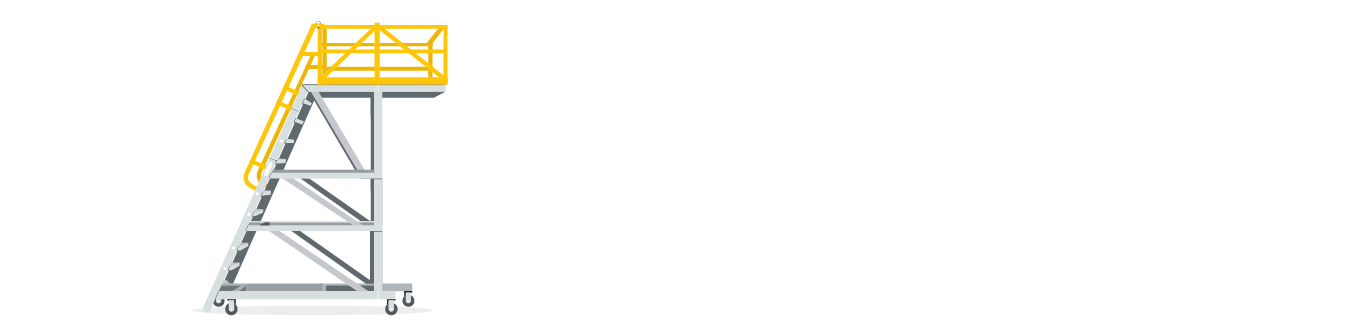
- Passive fall prevention. Fixed guardrails, perimeter protection, and elevated work platforms with guardrail systems prevent falls without relying on worker behaviour. Star Aluminium work platforms with full perimeter guardrails are an example of passive fall prevention.
- Work positioning systems. Travel restraint systems that prevent a worker from reaching a fall hazard zone are ranked above fall arrest.
- Fall arrest. Harness and lanyard systems that arrest a fall after it begins. These are personal protective equipment and ranked lower than passive protection because they depend on correct use and equipment condition.
- Administrative controls. Safe work procedures, training, supervision, and permits. These are ranked lowest because they depend entirely on human behaviour and adherence.
A common mistake in height risk management is moving too quickly to administrative controls (training and procedures) when passive engineering controls (platforms with guardrails) are available and practicable. Where a work platform can be used instead of a ladder, it should be used.
Choosing the Right Equipment
Equipment selection follows from the risk assessment. Key questions include:
- What height is required? Different tasks require different working heights. Match the equipment's reach or deck height to the task.
- How long does the task take? Brief tasks (under a few minutes, one-handed) may be appropriate for ladders. Extended tasks (both hands needed, repetitive, over a few minutes) warrant a work platform.
- What load is carried? Select load-rated equipment appropriate for the combined weight of worker, clothing, tools, and materials. In trade and industrial environments, 150kg minimum is the standard. Where loads are higher or use is continuous, 180kg industrial ratings provide additional capacity.
- What is the surface condition? Indoor flat surfaces suit fixed-height work platforms. Variable heights require adjustable platforms. Uneven outdoor surfaces require levelling capability.
- Is electrical proximity involved? Where live or potentially energised equipment is nearby, non-conductive fibreglass equipment is required.
Equipment Inspection and Maintenance
Access equipment needs to be inspected before each use and periodically by a competent person. Pre-use inspection for ladders includes checking rungs and steps for damage, checking feet and non-slip surfaces, checking locks and hinges on A-frame ladders, and confirming no structural deformation. For work platforms, inspection includes checking castors and locks, confirming guardrail connections are secure, checking the non-slip deck surface, and reviewing the WHS compliance plate.
Equipment that shows damage should be taken out of service immediately. A tag-out system ensures damaged equipment is not used while awaiting inspection or repair.
Documentation
Businesses subject to Work Health and Safety legislation in Australia need to be able to demonstrate that working at height risks have been identified, assessed, and controlled. Documentation that supports this typically includes a risk register identifying height access tasks, Safe Work Method Statements (SWMS) for high-risk construction work involving height, equipment registers with inspection records, and training records for workers using access equipment.
For equipment with WHS compliance plates (such as Star Aluminium work platforms), the compliance plate provides a reference point for the equipment register and inspection schedule.
Common Mistakes to Avoid
- Using a domestic-rated (120kg) ladder in a trade or industrial setting. The load margin is insufficient for daily commercial use.
- Standing on the top step of a step ladder. The top cap is not a standing platform. The maximum safe working position is typically the second-from-top step.
- Using a ladder as a work platform for extended tasks. If the task takes more than a few minutes or requires both hands, a work platform is the appropriate choice.
- Using aluminium ladders near energised electrical equipment. Fibreglass is required wherever electrical conductivity risk exists.
- Placing ladders on unstable or uneven surfaces without addressing the instability first. If the ground is uneven, secure the base before ascending.
Where to Go From Here
If your business is reviewing its approach to working at height, the most practical starting point is a task-by-task review of where height access is required and what equipment is currently being used. For many businesses, the result is that some ladder tasks are better served by work platforms, and some equipment in service is not appropriately rated for its application.
Aluminium Platforms stocks a complete range of ladders and work platforms across all load ratings and height configurations. Contact our team to discuss your specific access requirements, and we'll help you identify the right equipment for each application.